Market intelligence:
Budget 2027: Malaysia’s next growth advantage


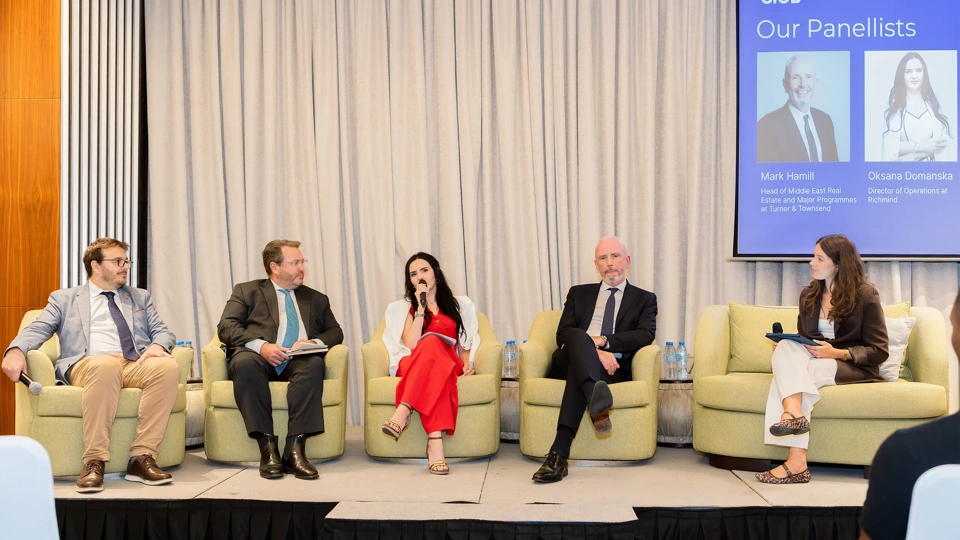

Despite geopolitical uncertainty, the UAE's projects market continues to demonstrate remarkable resilience. At a recent Turner & Townsend and CIOB panel discussion in Ras Al Khaimah, industry leaders explored the factors sustaining investor confidence, how organisations are adapting to risk, and what clients can do to create greater delivery certainty.
Panellists included:
Despite a backdrop of regional uncertainty, the market data tells a surprisingly positive story.
According to Ed James, project activity across the UAE has remained remarkably strong, with contract awards continuing to outpace expectations.
“The UAE project market is actually up 10% in terms of contracts awarded this year compared to the same period last year.”
While many expected geopolitical tensions to significantly dampen investment, the reality has been very different. Construction activity remains strong and projects already underway continue to progress, although some real estate launches have slowed as developers adopt a more cautious approach.
The market may even be on track for another record year for contract awards across the UAE and the wider region, underlining the underlying strength of project demand.
Ras Al Khaimah provides a strong example of this resilience, having seen a significant increase in hospitality, residential and infrastructure investment in recent years. But the wider lesson from the discussion was that investor confidence is becoming more discerning.
As Oksana Domanska explained, investors are looking beyond marketing, location and launch-driven momentum.
“Today, the customer is educated. They ask the right questions. They want to know the track record of the developer, they compare payment plans and they are more careful before they invest their money.”
Escrow arrangements, developer track record, delivery capability, feasibility and payment plans are all subject to greater scrutiny than in previous market cycles. Developers are responding by testing projects more rigorously before launch and bringing finance, sales, marketing and business development teams into decisions earlier.
This shift reflects a maturing market, where confidence remains high but expectations are becoming more sophisticated.
One of the strongest themes throughout the discussion was that project success is often determined long before construction begins.
Mark Hamill stressed that clients should first determine their operating model and establish how the programme will be governed and delivered. Whether adopting a lean client structure supported by a PMC or retaining a larger in-house team supplemented by seconded consultants, clarity on delivery arrangements should be established from the outset. Once the operating model has been defined, the key programme fundamentals must be aligned before delivery begins.
“Successful programmes start with clarity. Clients need a clear understanding of what they want to build, supported by a well-defined design brief, appropriate budget, a realistic programme and a contract strategy aligned to those objectives.”
As programmes increase in scale and complexity, effective governance becomes increasingly important. Clearly defined responsibilities and efficient decision-making processes help maintain momentum and reduce the risk of unnecessary delays.
“TThe decision-making and approval process can become one of the biggest constraints to successful delivery.”
An effective governance structure allows clients, consultants and contractors to make timely decisions, maintain progress and deliver with greater certainty.
Jeremy Munce also reinforced the importance of establishing the procurement and contractual strategy early, including how contracts interface, how disputes will be handled and how risks will be allocated.
Recent events have also reinforced the importance of risk management and contractual strategy, particularly around supply chains, delay and force majeure.
Jeremy Munce highlighted that projects often encounter difficulties when risks are transferred without considering who is genuinely best placed to manage them.
“Projects invariably go wrong when contractors simply sign whatever is put in front of them to win the project, only to discover later that they have assumed risks they cannot manage.”
The best outcomes come from allocating risk to the party most capable of controlling it, while ensuring there is sufficient contingency to respond when disruption occurs.
This becomes particularly important during periods of uncertainty, when delay can quickly translate into significant cost for both client and contractor.
Across the discussion, one consistent message emerged: collaboration matters.
Ed James noted that successful projects increasingly bring the full stakeholder group together early, including operators and facilities management teams, so decisions consider not only construction but the long-term operation of the asset.
“The projects that are successful are the ones where everyone collaborates at the earliest possible stage.”
Mark Hamill also highlighted the importance of creating an environment that attracts and retains the best delivery partners.
“Be a preferred client in the market”
This means establishing transparent and equitable commercial arrangements, including fair risk allocation, straightforward change-control mechanisms and reasonable payment terms. In a market where contractor capacity is constrained, these factors can influence the calibre of organisations willing to bid and, ultimately, the certainty of project delivery.
Jeremy added that contractors as well as clients need to take a mature approach to resolving issues, using the contract as a framework while remaining willing to consider pragmatic solutions that protect the project.
You can't build a project without contractors. If you behave fairly and collaboratively, they will respond positively in return.
While the panellists expect continued growth across the UAE, they predicted increasing focus on infrastructure investment.
Major programmes across transport, aviation and utilities are expected to play a critical role in supporting population growth and enabling future development. Ed James pointed to the shift towards large-scale infrastructure investment as a natural next phase after several years of strong real estate growth.
At the same time, the market is likely to place greater emphasis on delivery certainty, resilience and long-term value.
For developers, Oksana’s message was to focus on substance over noise:
“We should not follow large and loud launches. We should look at track record, transparency and evidence before we engage.”
The message from the panel was clear. The UAE continues to demonstrate remarkable resilience, but the organisations that will succeed in the next phase of growth will be those that combine ambition with strong governance, balanced risk allocation and a commitment to collaborative delivery.

Sign up for our quarterly newsletter - trends, market intelligence and expert perspectives.
Sign up for our quarterly newsletter - trends, market intelligence and expert perspectives.