Market intelligence:
Tariffs and turbulence


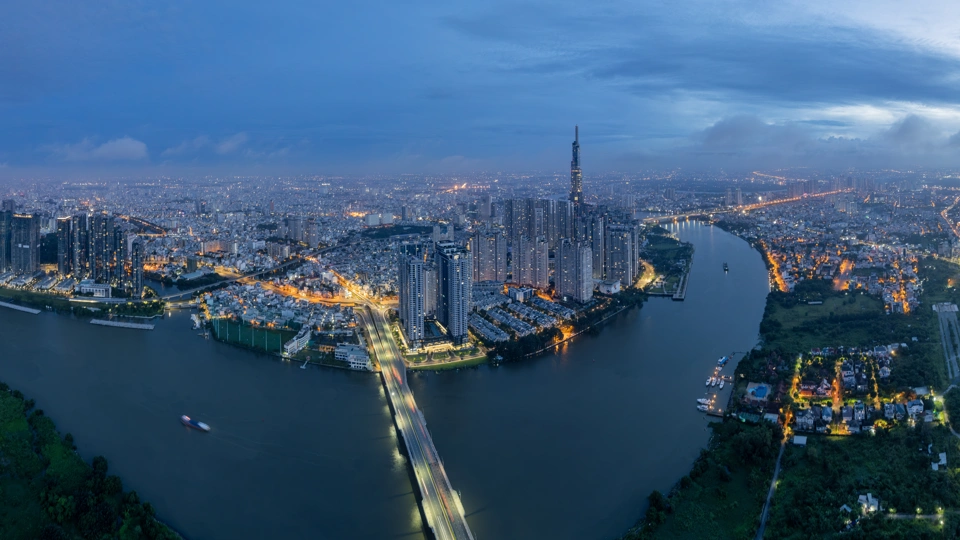

Vietnam's data centre market is expanding quickly. Foreign ownership is now permitted, land is being allocated in high-tech zones and construction costs sit among the lowest in Asia. However, developers must plan around delivery constraints like power and specialist labour.
Vietnam was a marginal player just a few years ago and is now catching the eye of global developers and investors, with cost advantages and digital growth putting it at the front of a regional trend. Our Global Construction Market Intelligence 2026 research classifies both Vietnamese markets (Hanoi and Ho Chi Minh City) as hot and ranks data centres as Asia's second strongest performing construction sector, carrying US$800bn of investment in the regional pipeline to 2030. Four key factors position Vietnam to secure a share of this pipeline, each bringing its own delivery implication.
The Telecommunications Law defines data centres as telecommunications facilities and allows 100% foreign ownership for the first time. Establishing a data centre business no longer requires a local joint venture, removing the biggest structural obstacle international developers faced.
“Licensing remains multi-stage: an Investment Registration Certificate, a local enterprise, then telecommunications approvals. Engaging local authorities and advisers early is the practical way through.”
A second change has had less attention. Vietnam's new Construction Law took effect on 1 July 2026, alongside a new decree on construction contracts. State appraisal of technical and construction drawing design has been removed, shortening approvals and moving design assurance onto the project owner. Payment, notice and contract administration requirements have tightened, so matters that were once settled informally now follow a defined process. Contracts signed and projects approved before 1 July 2026 remain under the previous framework, while anything signed after that date falls under the new regime. Organisations should audit live portfolios and determine which regime each contract sits under.
Most current and planned facilities sit in or near industrial and high-tech parks outside Hanoi and Ho Chi Minh City. Developers can lease land in these zones to expedite site acquisition, tapping areas with existing infrastructure, tax incentives, streamlined approvals and ready utilities access. Decision 2161 (Decision No. 2161/QĐ-TTg), introduced in late 2025, directs local authorities to allocate dedicated land for data centres in the same areas, easing one of the earliest hurdles developers face.
With market entry and land acquisition hurdles easing, the focus has now shifted to project delivery.
Power remains a constraint cited by local policymakers and industry reports. While the national grid is expanding to support industrial growth, provisioning large-scale stable power for hyperscale facilities remains an ongoing effort.
The Ministry of Industry and Trade reported that prolonged heatwaves pushed the national power system past 58,400 MW in 2026 with northern Vietnam surpassing 30,200 MW for the first time on record. The National Power System (NSMO) and Market Operator, attributes growth to strong economic performance and increasingly extreme weather. Its response includes working with EVN and EVNNPT to upgrade the 500kV and 220kV transmission networks and key substations, particularly in northern Vietnam. Nearly 4,000 MW of LNG-fired capacity was added in the Southeast region in 2026.
“Meeting this demand requires bringing new plants, substations and transmission lines into operation.”
This means an infrastructure programme competing for the same engineering and commissioning resource as the projects waiting to connect. Consequently, grid connection risks vary significantly between Hanoi and Ho Chi Minh City, making power availability a critical factor in early-stage feasibility studies.
Direct power purchase agreements, enabling data centre developers and operators to buy renewable energy from producers rather than through the grid, are part of the response. They align with Vietnam's net-zero 2050 pledge and its 39% renewable electricity target for 2030, which suits operators carrying their own commitments.
Water supply is more straightforward. Regional rainfall and resources are generally sufficient, shifting the design focus in Vietnam’s tropical climate toward cooling efficiency rather than water sourcing. However, water availability remains uneven across locations and seasons, with approximately 75% of the country's water resources concentrated during the rainy season and some areas experiencing shortages during prolonged dry periods. As a result, new facilities are increasingly adopting air-side economisation and water-efficient systems to optimise cooling performance while minimising water consumption.
Vietnam's engineering and construction sector has matured through years of industrial and commercial development. International firms and capable local contractors are delivering advanced semiconductor plants and data centres in-country and local teams have proven they can meet the demands of mission-critical work. The country produces many engineering graduates each year, national policy targets 75% of workers professionally trained by 2030, and over 80 million internet users are driving demand for digital services while supplying the workforce to build for it.
The pressure is narrower than it first appears. Our Global Construction Market Intelligence 2026 research records skilled labour shortages as the biggest single challenge facing Ho Chi Minh City, as both commercial and mixed-use schemes are competing with data centres and manufacturing for the same subcontractors, trades and plant.
“Taken together, this is a question of timing, not capability.”
Vietnam's mission-critical expertise is growing quickly and demand is growing faster. Markets expanding at this rate build capability fast, because contractors delivering semiconductor plants and hyperscale facilities carry that experience into the next project. The question for developers arriving now is whether capability arrives in time for their dates.
Cost tells the same story. Our Global Construction Market Intelligence benchmark covers conventional assets rather than data centres, outlining the work competing for the same trades. Average cost to build is US$1,079.3 per square metre in Hanoi and US$1,118.9 in Ho Chi Minh City, against US$1,427.0 in Johor Bahru and US$3,439.8 in Singapore. Of the 112 markets we measured, Hanoi ranks 100 and Ho Chi Minh City 96, with New York first.
Procure specialist scopes on a longer runway than local benchmarks suggest, because commissioning, mechanical and electrical capacity is being drawn towards data centre work across Asia. Developers should engage contractors during design rather than at tender stage and treat energisation as a critical path item.
“The next three to five years should bring continued double-digit expansion in capacity and investment, with policy aligning to what private developers need.”
Success is not automatic. Reliable power remains the priority and regulation will need to keep pace as the sector scales. The market fundamentals are strong: cost-competitive development, improving infrastructure and a workforce being built for this.
Few markets across Asia offer what Vietnam does right now: open entry, available land and a workforce building capability fast. Organisations that align with these expectations early are often better positioned to attract international investment, meet occupier requirements, and deliver assets that remain competitive over the long term.
Sign up for our quarterly newsletter - trends, market intelligence and expert perspectives.
Sign up for our quarterly newsletter - trends, market intelligence and expert perspectives.