Market intelligence:
Tariffs and turbulence


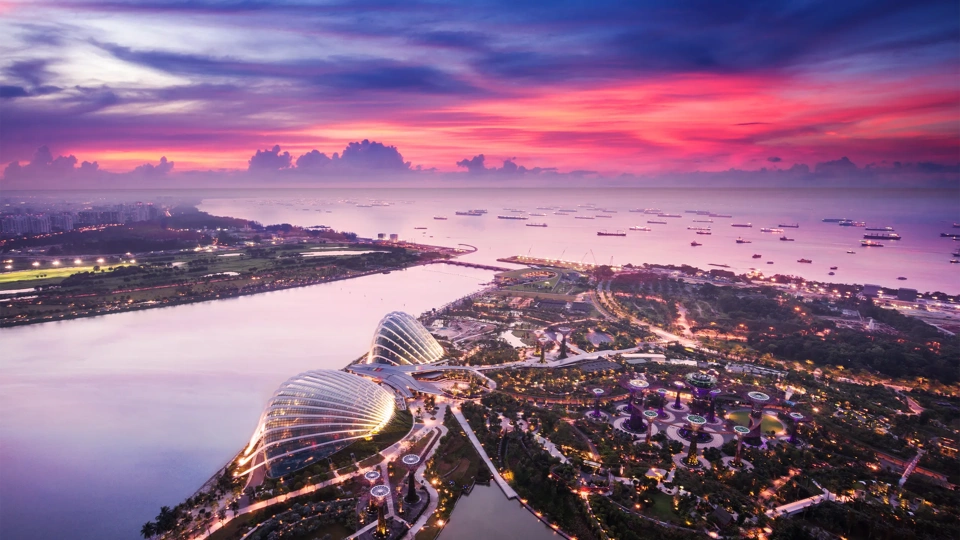

Singapore is entering the second half of 2026 with its busiest full pipeline in a decade.
On paper, Singapore’s pipeline looks stronger than it has in years. Construction demand reached S$50.5bn in 2025, the strongest year in a decade and the Building and Construction Authority (BCA) expects S$47bn to S$53bn in 2026. Changi Terminal 5, the Marina Bay Sands expansion and two rail extensions anchor a full pipeline stretch well into the 2030s.
However, Middle East conflict escalated earlier in the year, pushing energy and freight costs sharply higher. Notwithstanding this impacting the market with a high reliance on supply chain imports and import-sensitive cost base, tender prices remained relatively stable in the first half of the year. The market now holds two truths at once: demand is more certain than it has been in years, while costs are less predictable than at any point since the COVID-19 pandemic.
Tender prices held broadly stable throughout the first half of 2026, despite rising input costs. However, that stability may be a delay, and not a sign of strength. With the Middle East conflict affecting markets since late February, uncertainty continues to persist. However, no major escalation has been evident in tender prices to date. Market sentiment and feedback remain mixed.
Contractors have largely held their pricing to secure work, absorbing cost pressure rather than passing it on. However, it's worth noting that any cost increases that may come are typically reflected in tender prices quickly. Whereas downward adjustments tend to lag due to existing contractual arrangements and procurement commitments.
“Analysts don't expect the current position and behaviours to hold indefinitely.”
Construction cost inflation was 1% in 2025. Barring any further global uncertainties, construction cost inflation is projected to sit at approximately 4% in 2026 and 5% in 2027.
Even if market conditions stabilise, much of the cost already absorbed across the whole supply chain is unlikely to be recovered. As a result, the market is expected to normalise at a higher baseline rather than return to pre-disruption pricing levels.
A budget built on first-half tender data may therefore rest on a number that no longer reflects the market. Accordingly, it's important to note that while market-wide forecasts provide an indication of overall cost trends, actual project cost movement will depend on project-specific factors such as type, procurement strategy and phasing.
Between February and April 2026, crude oil rose 58.9% and bitumen 55.1%, while structural steel moved 0.9% and copper and aluminium 1.2%. The pressure points come from energy and logistics rather than in the underlying materials.
Materials sourced predominantly from Asia, including steel from China, remain relatively insulated from the routes under strain. However, goods routed from Europe face longer and less certain lead times, from kitchen appliances, toilet-ware and washer-dryers through to specialist plant and data centre equipment.
“Energy exposure follows its own pattern, with civil and infrastructure works reliant on diesel-powered machinery and bitumen being impacted the most.”
Singapore’s Government moved early, introducing an ex-gratia cost-sharing scheme for diesel and bitumen on critical public sector projects between March and May 2026. The scheme has since lapsed, and the industry is appealing for its return while material pressure persists.
With freight disruption and backlog still on-going, this looks like a mid-term repricing, not a passing spike.
Stockpiling itself isn’t new to Singapore, and holding inventories of key materials has long been the standard on major infrastructure. What has changed is precision and timing. This includes teams bringing orders forward for long-lead items and asking contractors to hold stock ahead of plan. This focuses on the categories genuinely at risk rather than the whole supply chain.
The motivation is less about price than certainty. Worsening shipping conditions could delay projects, even if material costs stay steady. This makes early procurement a risk decision, not a cost one.
Contractors have adopted a cautious approach and adjusted their tendering strategies in response to prevailing market conditions.
Before the COVID-19 pandemic, contractors were generally more willing to accept risks and manage them as projects progressed. Today, risks are thoroughly assessed during the tender stage, with increased emphasis placed on the allocation of risks among project stakeholders. Without sufficient clarity, risks that are disproportionately allocated to contractors will inevitably be reflected in tender prices.
“To mitigate this, developers should engage with contractors early, clearly define the project scope and establish equitable risk sharing mechanisms.”
Packaging and sequencing carry similar weight. Releasing multiple major tenders at once strains specialist trades and thins participation. Whereas staggering releases and sizing the packages to contractor capacity protects competition and delivery.
Procurement has evolved into a two-way engagement process, moving beyond the traditional model of clients calling tenders and contractors simply submitting bids. There’s now greater collaboration between stakeholders to align project objectives, risks and delivery expectations.
Singapore’s construction pipeline remains strong, but the market continues to adjust to a higher cost baseline. Given the industry’s heavy reliance on imports, cost and supply chain disruptions will continue to be key factors impacting the built environment.
Waiting for geopolitical tensions to subside isn’t a viable strategy, as cost pressures are likely to persist even after conflicts ease. Developers, owners and contractors should instead focus on building resilience into their projects through proactive measures such as:
Projects that adopt these measures will be better positioned to navigate uncertainty, improve project delivery and achieve successful outcomes in an increasingly complex market environment.

Sign up for our quarterly newsletter - trends, market intelligence and expert perspectives.
Sign up for our quarterly newsletter - trends, market intelligence and expert perspectives.